Each of Our Catholic Churches Tells a Love Story

April 18th, 2013

This is a special moment in the life of the Catholic Church, as we carry out the work of the New Evangelization by deepening and sharing our Catholic faith, and as we celebrate a Year of Faith coinciding with the 50th anniversary of the opening of the Second Vatican Council.

Our Archdiocese of Washington, meanwhile, is preparing to mark its 75th anniversary with a synod that will convene on Pentecost in 2014.  This event, for which we have already begun preparations and listening sessions across the archdiocese, will give the faithful an opportunity to participate in the work of our local Church as we review its mission in manifesting the kingdom of God here in our community.

As we proceed, it is important for us to understand our frame of reference as Catholics — that the Church is the home of God’s word and the sacraments, and it is the enduring, visible presence of Christ in the world today. As members of the Catholic Church, the mystical Body of Christ, we are part of God’s family, baptized into the one, holy, catholic and apostolic Church founded by Jesus.  That is one sense in which we use the word “church,” but another common usage is in reference to the building in which we assemble to pray and worship.

Mike Aquilina and I have just completed a new book, The Church: Unlocking the Secrets to the Places Catholics Call Home. This book is about church buildings and it explores the architectural and spiritual components of the places that are truly “home” to Catholics, where from life’s beginning to its end, we experience God’s word and the sacraments.  In learning about the church, we can gain a greater understanding of and appreciation for the Church.

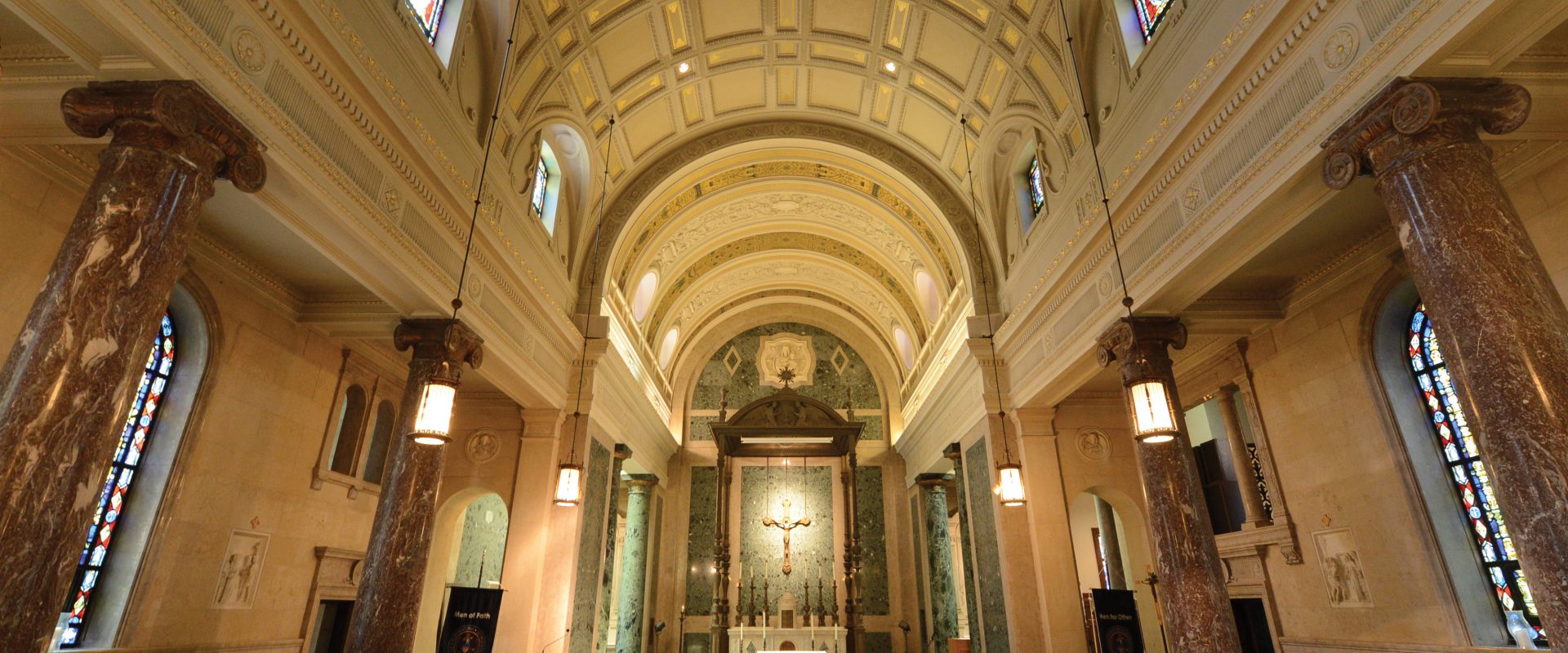
Every part of a Catholic church building is rich in meaning and mystery, theology and history. Every furnishing or ornament reveals some important detail of the story of our salvation. That is why our churches – whether they are on city streets, in suburban neighborhoods or in the rural countryside – truly stand as holy ground, where we encounter Christ in his word, in the sacraments and in each other. God is present there. Every one of our churches, whether a soaring Gothic cathedral or a simple country church, tells a love story – a story of God’s love for us, and of our love for God.

As co-authors, we approached this subject from two distinct viewpoints. Mike Aquilina is a married layman who has prayed with his family in the pews of hundreds of churches and tried to see the arches and vaults, ceilings and cloisters through his children’s eyes. I am an ordained priest of the Catholic Church who has celebrated Mass at the altar for 46 years. Working together, we hope to share a panoramic vision of our churches.

We conceived of this book as a companion volume to our earlier book, The Mass: The Glory, the Mystery, the Tradition, which is now available in paperback.  “The Mass is what Catholics do. It’s the heart of Catholic life,” we wrote, as we took a walk through the Mass, stopping to see the sights along the way, from the opening procession to the closing prayer. We hope this book will help deepen people’s understanding of and love for the Mass, by looking at the historical and biblical roots of each part of the Mass.

With our new book on Catholic churches, we likewise take a walk through the features in a typical church, from the front door to the holy water font at the entrance to the spires overhead to the gleaming stained glass windows along the walls. Every Sunday at Mass, we see the tabernacle, the altar, the ambo, the crucifix, the presider’s chair and the candles, we hear the bells and the choir. Each of these has meaning, none of them is superfluous or arbitrary.  Hopefully, this book will help foster a deeper appreciation for the important role of each of these features in a church, their history in our worship and their relevance to our prayer life today.  In this way, the reader should gain a greater understanding of the Church as the mystical Body of Christ.

The goal of the book on the Mass, and now this one about Catholic churches, was not to produce a guidebook, but to help Catholics encounter Jesus more fully in the Mass and in our churches.  Perhaps reading about and understanding a church will foster deeper prayer and a more meaningful experience of God’s presence there. Our churches are not museums or tourist attractions. They are temples of the living God who wills and wishes to meet us there. And that is why they are the places Catholics call home.

Homily from Mass with George Washington University Students

April 16th, 2013

On Sunday, April 14, I delivered the following homily at a Mass with GWU students in support of their chaplain, Fr. Greg Shaffer.

Dear brothers and sisters in Christ, it is always a pleasure for me to come to this campus ministry program Mass here at Saint Stephen’s Church that serves all of you who are part of the George Washington University family.

In a particular way, I want to offer a word of support and encouragement to your chaplain, Father Greg Shaffer.  All of us have come here this evening for two purposes: to celebrate Mass and to stand in solidarity with a good priest.

I am inspired by the ministry here.  I often use Father Shaffer and you students of the Newman Center as examples of the New Evangelization.  In fact, my recent book entitled New Evangelization: Passing on the Catholic Faith Today begins by describing my visit here and witnessing the vitality of this chaplaincy.

In today’s Gospel, we are reminded of two very important elements in the life of the Church, foundational elements: that Jesus is risen from the dead and offers us a whole new way of life, and that Jesus chooses, appoints and empowers shepherds of his flock.

In the encounter between Jesus and Peter, Jesus asks Peter, “Do you love me?” and in answer to the affirmative response of Peter, Jesus said, “Feed my sheep.”

For 2,000 years Successors to Peter and those who work with the bishops – priests all over the world – have that same charge, feed Jesus’ flock.

The whole world watched one month ago as the Church chose the most recent Successor to Peter – Pope Francis. He continues to do the same work that was assigned to Peter – to every priest.  “Feed my sheep!”

With what is the flock to be fed?  There are two great sources of nourishment for those who claim to be a part of the flock of Jesus, those who wish to be associated with the risen Lord, those who have encountered Christ alive in their hearts,   in the world, in the Church today.  Those two sources are the Word of God and the sacraments – the Eucharist.

But before we even begin to talk about the Word of God and the sacraments of the Church as that substance with which the flock is fed, we have to ask, who are the members of this flock?  Who are the sheep of Jesus’ flock?

If anything is clear from the Gospel, it is that some have chosen to follow Jesus.  Jesus has chosen some to work with him in guiding his flock.  But the choice to follow Jesus and his visible presence in the world today, that is, the Church, is rooted in the free will of people who say, “I would like to be your disciple.  I want to be with you.  I want to be a part of your Church.”

Not all who hear the words of Jesus, not all who hear the words of the Church, not all who hear the words of the Gospel, the Word of God, choose to follow.

With respect to those who do not choose to follow, we do not impose those words of the Church on anyone.  We propose the ways of the kingdom of God in terms that the world can understand and examine, in terms they may freely accept or reject.

There are recorded in the Gospel many episodes of those who found what Jesus said to be simply “hard sayings” and they would no longer walk with him.

When Jesus was proclaiming his teaching that his own Body and Blood would be food for his flock, that the Eucharist that he would establish the night before he died would be the sustenance of his family, there are those who simply walked away.  They said we cannot take this, we cannot accept this, we are not going to follow this.

Jesus did not respond by changing the teaching.  Even when they said to him you need to be current, you need to be contemporary, you need to be politically correct, you need to be with the times, Jesus did not say, “Oh, then, I will change my teaching.”  He simply said, “No, this is my Body, this is my Blood, this is food for you, this is sustenance for eternal life.”  And some simply walked away.

Jesus continued to be a countercultural voice.  Jesus did not change his teaching – indeed he could not change his teaching because what he teaches is truth.

He announced with firmness that he had come from God, that God loves us, that there is a way to live that is in conformity with God’s plan and will.  He proclaimed that he had come to confirm the commandments of God.  He proclaimed that he had come to bring us new life and a way of walking with him. He announced the Beatitudes. He announced his law of love.

All of this Jesus offers to us.  What he does not offer to us is the right to change his words, his vision, his revelation, his teaching of truth and love to conform with any particular cultural demand today.

Priests, your chaplain, pastors all over this diocese, bishops all around the world are trying to be faithful to that Gospel teaching.  That is what they announce.  This is who they are – preachers of the Gospel of Jesus Christ.  They cannot change our Lord’s message.  They pass on the Good News.

Yet, there are those who claim that voices for the Gospel should be silenced, that we should be silenced.  There are those who say there is no room for any other view but their own.  As the first reading for the liturgy today reminds us, “When the captain and the court officers had brought the apostles in and made them stand before the Sanhedrin, the high priest questioned them, ‘We gave you strict orders, did we not, to stop teaching in that name?’” (Acts 5:27-28).  But the text goes on to point out, “But Peter and the apostles said in reply, ‘We must obey God rather than men’” (Acts 5:29).

We are not talking about ancient history and faraway lands.  We are talking about our own lived experience in our country.

The Church’s long history recounts many examples of efforts to silence her teaching.  Pope Francis is the 266th Pope.  Nearly all the first 60 Popes were put to death for the faith – by those in political power who disagreed with Jesus, his Gospel, and therefore his Church’s shepherds.

We have seen this over and over again, in various forms of narrow-minded discrimination and blind bigotry.

Catholics have suffered at the hands of all kinds of movements, the Ku Klux Klan, the Know Nothing Party, the burning of Catholic churches and convents in various parts of the then-Protestant colonies.  This history teaches us that, like any freedom, religious liberty requires constant vigilance and protection, or it will disappear.

And so, here we are.

The idea that the pastor of a parish today or the chaplain of a religious community and campus ministry today should simply be silenced because he faithfully announces the Gospel of Jesus Christ – that he should not be allowed to engage in dialogue with our culture, even in a place that is dedicated to the free and diverse expression of ideas – may seem somewhat radical today, but you have to remember there have always been those who try to force their totalitarian views on all of us.

When we talk about marriage, when we speak about the dignity of human life, when we teach about the natural moral order, these are all elements that we find deeply rooted in the consciousness of the Judeo-Christian tradition.  Just because someone wants to change all of that today does not mean that the rest of us no longer have a place in this society.

Remember after someone says you cannot speak here, then comes the sentence, “And you do not belong here.”

I want to make something very, very clear.  Our response must be the response of Jesus Christ, the response of his Church, a response rooted in love. When we are attacked, there will always be the temptation to respond in kind. But we must respond out of who we are. We are followers of Jesus Christ.

But we also need to remember that we all know people – homosexual and heterosexual alike – who may disagree with particular teachings of the Church, but do not express that disagreement by demanding that the Church and her ministers be silenced.

We all struggle to live up to the demands of the Gospel – even when we fail – because we know that what Jesus and his Church teach are the words of everlasting life.

The Church calls us to keep trying to draw closer to Christ.  This we do – not because we are perfect – but because he is the way, the truth and life.

We must be inclusive, we must recognize the bonds of mutual charity and we must continue to reach out to all of those brothers and sisters who come to Mass to be with us.  We must be allowed to do so freely.

The Catholic Church welcomes everyone and tries to walk with them on life’s journey while at the same time upholding a moral law by which we are all obliged to live.

We have so much more to offer and so does America.  There should be tolerance and respect among all people.  There has to be room enough in America in a society as large, as free and pluralistic as ours to make space for all of us.

Dear brothers and sisters, never be ashamed of Christ, his Gospel, his Truth – or your identity as Jesus’ disciples.  Always be proud of who you are.

Thank you for standing up for the freedom to speak our faith and thank you for standing up for your chaplain.

God bless him and all of you.


Prayer: Our Most Powerful Tool

April 15th, 2013

The news of the explosions today in Boston has stunned us all. We grieve for those killed and join with people of all faiths in praying for them, for the wounded in the attack, for their family members and friends and for the first responders and emergency workers tending to the injured. Our most powerful tool right now is prayer.

Earlier today the Archdiocese of Boston posted the following: “As reports of death and injuries are reported, we ask you to please turn to the Lord each time to pray for them and for those who love them that they would receive the consolation of the Holy Spirit, the mercy of God, and the loving maternal embrace of our Blessed Mother.”

While at this time we do not know the cause of these explosions, we know that the answer to the world’s darkness is to open our hearts to the light of Christ. Blessed John Paul II encouraged people to confront this “culture of death” by building a civilization of love, by reflecting the love of Christ in our daily lives. Our faith in the Risen Christ in such times of sorrow offers us the confident hope that death shall not have the last word.

Lord our God,
You are always faithful and quick to show mercy.
Our brothers and sisters were suddenly taken from us.
Come swiftly to their aid,
have mercy on them,
and comfort their families and friends
by the power and protection of the Cross.

We ask this through Christ our Lord.
Amen.

[Prayer from the Order of Christian Funerals]

“Go out!”

April 11th, 2013

At his first general audience on March 27 in Saint Peter’s Square, Pope Francis repeated a phrase worth remembering and living: “Go out!”

A few days before Easter, our new Holy Father was reflecting on what it means to live our faith during Holy Week, and in a deeper sense, to walk with Jesus every day of our lives. Pope Francis said:

“Living Holy Week is always going deeper into God’s logic, into the logic of the Cross, which is not first and foremost a logic of sorrow and death but one of love and the self giving that brings life. It is entering into the logic of the Gospel. Following, accompanying Christ, staying with him when he asks that we ‘go out’: out of ourselves, out of a tired and habitual way of living the faith, out of the temptation of locking ourselves in our own schemes that wind up closing the horizon of God’s creative action….

“Holy Week is a time of grace that the Lord gives us to open the doors of our hearts, of our lives, of our parishes…of our movements and associations, to ‘go out’ and meet others, to draw near them and bring them the light and joy of our faith. To always go out with the love and tenderness of God!”

Those two words – “Go out!” – summarize our call to the New Evangelization, to deepen our Catholic faith, to grow in confidence and be strengthened in its truth, and share it with others. Notice how Pope Francis emphasizes that to “go out” as witnesses of Jesus means that we “meet others” and “draw near them and bring them the light and joy of our faith.” We must do it with love, always with love, God’s gift to us.

During his March 31 Urbi et Orbi Easter blessing to the city of Rome and to the world, Pope Francis spoke about the need to share the joy and new life of the risen Christ, with those we love, and with those who are suffering: “What a joy it is to announce this message: Christ is risen! I would like it to go out to every house and every family, especially where the suffering is greatest, in hospitals, in prisons….Most of all, I would like it to enter every heart, for it is there that God wants to sow this Good News: Jesus is risen, there is hope for you, you are no longer in the power of sin or of evil! Love has triumphed! Mercy has been victorious! God’s mercy always triumphs!”

Jesus, our risen Lord, offers us hope, he offers us love, he offers us mercy, and that love, as our Holy Father says, has triumphed over sin and death, and it can triumph over any sufferings, disappointments or misunderstandings in our lives that may have distanced ourselves and others from Christ.

As Catholics, we must move beyond the misconception that evangelization is something that other Christian denominations do. Jesus himself establishes evangelization as being of the very nature and essence of the Church when he gives his disciples the commission to evangelize, to announce the good news “to all the nations (Matthew 28:19)” and to spread the Gospel by going forth “into the whole world (Mark 16:15).”

Jesus calls us personally to share his love with others. Our Lord is not looking for bystanders – he calls us to be his witnesses, to walk in his love and his friendship every moment of our lives – through our actions as well as our words. For most of us, this call to evangelize won’t involve ringing doorbells or handing out pamphlets; rather, it should be a matter of living and sharing our faith in the quiet moments of our everyday lives, at home, at work, in the community, maybe even on the sidelines of a soccer field or the checkout line at the supermarket. We all know family members and friends who have drifted from the faith or never heard about it, and whose lives could be transformed and made new by Christ.

So in this Easter season – indeed, in every season – let us heed Pope Francis’ words: “Go out” and bring Christ’s love and life to the poor and forgotten who are our brothers and sisters. “Go out” and share the Good News of the risen Lord with our family members and friends, share Jesus who brings us new life and eternal life, our Savior who can transform hearts and change the world. Go out!

The Annunciation of the Lord

April 8th, 2013

The Annunciation, Henry Ossawa 1898

Today, the Church celebrates the Annunciation of the Lord.  Normally, this Solemnity is observed on March 25, but because that day fell within Holy Week this year, the celebration has been transferred to today.  For most of the year, the Church gathers each day to pray the Angelus, except during the Easter Season, when the Regina Caeli is recited instead.  In the Angelus, we recall the appearance of the angel Gabriel and the response of the Virgin Mary, “Behold the handmaid of the Lord.  Be it done unto me according to Thy word.”  And the Word was made Flesh; and dwelt among us.

To understand God’s plan for our salvation after our fall from grace calls us to reflect on the role of Mary. When we turn to the pages of sacred Scripture we see unfolding the dynamic of this divine mystery.  Gabriel’s message to Mary that she was to be the Mother of God, and her response to it, set the stage for everything else that will happen.  Salvation of mankind through the Incarnation of the Eternal Word and the Paschal Mystery all hung on Mary’s response.  With her “fiat” – her “yes” to God – came the beginning of a whole new order, a new creation.

The Virgin became a mother, and it is an enduring motherhood that extends to all the faithful.  As former Cardinal Jorge Bergoglio said in a homily in 2011 before he became Pope Francis, the motherhood of Mary is one with “a double childbirth: one in Bethlehem and another at Calvary. It is a motherhood that contains and accompanies the friends of her Son, who is the only reference until the end of time. [She is] a mother who opens spaces for grace to enter in – that grace that revolutionizes and transforms our existence and our identity; the Holy Spirit that makes us adopted sons, frees us from all slavery and, in a real and mystical possession, gives us the gift of freedom and cries out from within us the invocation of the new belonging: ‘Father!’”

In the Virgin Mother is the pure, living dwelling-place of God. She teaches us that God does not dwell in buildings of stone, but in the living hearts of those who accept him.  Because Mary is totally with God, she is also close to us.  For this reason, she is rightly called the mother of every consolation and every help.

Yesterday, we celebrated Divine Mercy Sunday, for which we express our gratitude to both God and Mary, Mother of Mercy.  As Blessed John Paul II explains in Veritatis Splendor (The Splendor of Truth), “Mary experiences, in perfect docility to the Spirit, the richness and the universality of God’s love, which opens her heart and enables it to embrace the entire human race. Thus Mary becomes Mother of each and every one of us, the Mother who obtains for us divine mercy.”

Mary is truly “blessed among women.”  She stands at the center of the mystery of salvation, a mystery which embraces all of humanity.  To this most gracious advocate, we rightly say that she is our life, our sweetness, and our hope, imploring that she turn her eyes of mercy toward us and show us the blessed fruit of her womb, Jesus.  Standing by her side, remaining with her, let us also ask this Holy Mother of God to pray for us, that we may be made worthy of the promises of Christ during this Year of Faith and always.

Alleluia! Christ is Risen!

March 31st, 2013

The Resurrection by Carl Heinrich Bloch

Just over two weeks ago, we witnessed the election of a new Chief Shepherd – Pope Francis.  The Chair of Peter is once more filled.  Now on Easter Sunday, with joy and exaltation, the entire Church throughout the world proclaims once again, as it has done for two millennia, “Christ is Risen!”  You and I are able to confidently proclaim this because of the unbroken line from Peter, who witnessed the events of the first Easter Sunday, through the centuries to John Paul II to Benedict XVI and now to Francis.

The story of Jesus should have ended when he was placed in the tomb.  But it was only the beginning.  He was dead, truly dead, but Christ – the Word made flesh –  destroyed death so that we might live in him.  We come together as a people on this day so that we might, once again, see the signs – the empty tomb, the progress of Christ’s living Church through 20 centuries, and all of the works of love and charity lived out by that Church over 2,000 years – and also to hear the witnesses, Mary Magdalene, Peter, John, the other apostles and disciples who saw Jesus alive, as well as the testimony of the martyrs and saints, all of those witnesses year after year after year.

The Gospel tells us of the empty tomb, of the first witnesses, and of the need for us to believe.  We are part of a faith family, a living tradition, a connectedness through the Church to the Apostles.  So we can say we are his witnesses!  We are called to see the signs, to hear those who have gone before us, to believe, and then testify to all the world: Christ is Risen!  We cannot keep this Good News to ourselves.  We must share it and invite others to rejoice in it.

We must share the Good News of the Risen Lord and by his grace, we must allow him and his love and truth to shine through us to others, so that we might provide the face of Christ to them.  We are meant to be signs and instruments of salvation in the work of Christ, the light of the world and salt of the earth for the redemption of all.  This is the mission that Jesus himself has given to us, to be his witnesses to the ends of the earth, to make disciples of all nations – “As the Father has sent me, so I send you” (Jn 20:21; Mt 28:19; Acts 1:8).

In his meeting with the College of Cardinals after the conclave, Pope Francis told us that it was his desire that, inspired by the celebration of the Year of Faith, all of the faithful would “strive to respond faithfully to the Church’s perennial mission: to bring Jesus Christ to mankind and to lead mankind to an encounter with Jesus Christ, the Way, the Truth and the Life, truly present in the Church and also in every person. This meeting leads us to become new men in the mystery of Grace, kindling in the spirit that Christian joy that is the hundredfold given by Christ to those who welcome him into their lives.”

But in sending us, in giving us this mission to proclaim the truth of the Resurrection and the invitation to share in this eternal life, Jesus does not leave us to fend for ourselves.  Our Holy Father reminded us that we can be “quite certain that the Holy Spirit bestows upon the Church, with his powerful breath, the courage to persevere and also to seek new methods of evangelization, so as to bring the Gospel to the uttermost ends of the earth (cf. Acts 1:8).  Christian truth is attractive and persuasive because it responds to the profound need of human life, proclaiming convincingly that Christ is the one Savior of the whole man and of all men. This proclamation remains as valid today as it was at the origin of Christianity, when the first great missionary expansion of the Gospel took place.”

After seeing the empty tomb and encountering the Risen Lord, Peter went out and gave witness to this Good News, a truth which brightens and transforms lives, instilling hope, courage, and perseverance in every age.  He continues to do so, now bearing the name Francis.

This Easter season, let us simply take on our own responsibility as witnesses to bear testimony so as to renew the world – Christ died and rose, never to die again.  This is our faith, this is our great hope, life everlasting in the fullness of love that is Jesus Christ.  May you carry in your hearts today and every day, the splendor and joy of the simple proclamation of those on that first Easter, of Peter and of every believer since, “Christ is risen, Christ is truly risen, Alleluia!

Holy Saturday: Learning to Live through Death

March 30th, 2013

Today, Christians awake to a silent world.  It is not a literal silence but rather a spiritual one.  We recognize spiritually the sad coldness of death.  This is the day we remember that our Lord truly died and was placed in the tomb.  This is a time for quiet reflection.  What if this were the end of the story of Jesus? What would life be like – how would it be different?

Many of us know what it is like to lose a loved one.  At the same time, we have discovered something more when facing the prospects of life without that person who was particularly loved by anyone of us – a parent, a child, a spouse, a friend.  By the gift of faith, we have learned that, while we will always miss the person who has died, our loved one has been given the promise of life eternal with the Lord.  It is our hope, too, that one day we will share this new and everlasting life with them.  Life has not ended, it has been transformed.

Today is the day we recognize this journey from death to life.  Today we learn how to live through death. Holy Saturday is the time of anticipation of the Resurrection of our Lord and his victory over death.

At sundown, the quiet of Holy Saturday gives way to the celebration of the Easter Vigil in which we tell the rest of the story.  We remember why life is different.  Our quiet reflection gives way to the wonder of the women who go to the tomb mourning and find the tomb empty!  Like the women, in this moment we realize that Jesus’ story is our story.  Jesus has conquered death. Here our story begins.

In the Eastern Church, on the morning of Easter the Easter Homily of St. John Chrysostom is read. (In our tradition, the homily is read in the Liturgy of the Hours.) It is a beautiful exhortation of the Resurrection.  Its final words capture the transition we make in our hearts and in the life of the Church on this day.  St. John preaches:

“O death, where is thy sting? O Hades, where is thy victory?

Christ is risen, and you are overthrown! Christ is risen, and the demons are fallen!

Christ is risen, and the angels rejoice! Christ is risen, and life reigns!

Christ is risen, and not one dead remains in a tomb!

For Christ, being raised from the dead, has become the first-fruits of them that

have slept. To Him be glory and might unto the ages of ages.

Amen.”

Our day ends by being joined to Christ in a new creation.  Whether at the celebration of the vigil tonight or tomorrow at Mass, we will sing “Christ is risen, Christ is truly risen.  Alleluia, Alleluia!”  It takes on special meaning on this day because as a result of our participation in the sacraments, not only is Christ risen, but we are risen in him and we have been given new life as a part of his new creation.

The Royal Throne of Christ the King

March 29th, 2013

Christ Crucified by  Diego Velázquez, 1632

In the early morning hours of Friday, while he was praying in the Garden of Gethsemane, Jesus was arrested, having been betrayed with a kiss.  When the soldiers and guards said they were looking for Jesus the Nazorean, he replied, “I am” (Jn 18:5).  He was then taken before the authorities, the high priest and Sanhedrin, where people made accusations against him.  Jesus was asked, “Are you the Messiah, the son of the Blessed One?”  He answered, “I am” (Mk 14:61-62).

Condemned for blasphemy, he was taken before Pilate who first had Jesus scourged and then condemned him to death even though he knew him to be innocent.  Pilate literally washed his hands of the matter, giving in to the crowd who shouted, “Crucify him!”

When we walk into church on Good Friday, we notice that the sanctuary lamp is not lit.  We do not genuflect because no one is there – the Tabernacle is empty.  The Church intends for us to experience the sad emptiness and coldness of death.   There is no Mass, but instead a Commemoration of the Passion of the Lord.  Following the Liturgy of the Word, in which the entire Passion narrative is read, the solemn Adoration of the Holy Cross takes place.  A cross is presented with the words, “Behold the wood of the Cross, on which hung the salvation of the world,” to which the people reply, “Come, let us adore.”  Then all are invited to come forward and feel the hard wood of the cross as we make an act of veneration.  Although there is no Mass, Holy Communion is distributed because the Eucharist sustains us especially in dark times.

Pilate had asked Jesus, “Are you the King of the Jews?”  Jesus responded, “You say I am a king.  For this I was born and for this I came into the world, to testify to the truth. Everyone who belongs to the truth listens to my voice.”  But Pilate was not interested in truth, famously asking, “What is truth?”  It is a question that our contemporary age of relativism and aggressive secularism has adopted for itself in its own attempt to bleach out God from society.

Pope Francis observes that it is precisely on the Cross that the kingship of Jesus shines forth in divine fashion: “his royal throne is the wood of the Cross!”  It is upon this throne of wood that “Jesus takes upon himself the evil, the filth, the sin of the world, including the sin of all of us, and he cleanses it, he cleanses it with his blood, with the mercy and the love of God….

”Jesus on the Cross feels the whole weight of the evil, and with the force of God’s love, he conquers it, he defeats it with his resurrection. This is the good that Jesus does for us on the throne of the Cross. Christ’s Cross embraced with love never leads to sadness, but to joy, to the joy of having been saved and of doing a little of what he did on the day of his death.”

However, in order to rise with Christ to a new life of grace in the Resurrection, we must die to our old life of sin with him on the Cross.  We must stand there at the foot of the Cross with Mary, whose soul was pierced as with a sword this day, watching her Son die.  We come to the foot of the Cross because we recognize what Jesus endured for us.  We realize the possibility of our redemption.  In spite of our failures, our sins, our weakness, Jesus not only loves us, but he hung on the Cross for us.  He shed his blood unto death for each of us.  Now, today, he invites us, as he always has, to come to his Cross and see in it our salvation, our forgiveness, our newness.

After Jesus breathed his last, and his own side was pierced, the divine mercy of his precious blood and water poured forth from his side.  Because the Sabbath was near, Mary had little time to hold Jesus in her arms before he was bound with burial cloths and laid in the tomb.

Jesus was dead.  That should have been the end of the story.  But it wasn’t.

The Mass of the Lord’s Supper: The Story of God’s Love for Us

March 28th, 2013

Jesus Washing Peter's Feet by Ford Madox Brown, 1852-56

For five weeks of Lent, we prepared ourselves through works of charity, self-sacrifice and personal conversion toward God.  Now, on Holy Thursday, we enter into the Sacred Paschal Triduum with the Mass of the Lord’s Supper.  On this holy night, we see Jesus showing his apostles how they are to lead – through service.  Our Lord gets down on his knees and washes their feet (Jn 13:4-17).  In like fashion, the priest at this Mass will wash the feet of twelve people to remind us that the call of the priest, and each of us, is to serve and not to be served – to love one another as Jesus loves us.  We are capable of showing love for others in many ways, maybe not as dramatically as washing their feet, but in a way that truly conveys compassion: by a word of forgiveness, by a gesture of welcome, by a sign of caring.

The Son of God descended from heaven and became flesh in order to serve with love, to give the entirety of himself.  The night before he allowed himself to be handed over to authorities, Jesus also instituted the Eucharist and the priesthood that brings us this Blessed Sacrament.  It is here where we literally savor the gift of the Lord.   When the priest – who acts in the person of Christ – takes the bread and the wine and says, “this is my Body . . . this is my Blood,” Jesus is really truly present and he asks us to receive him into our lives, into the fullness of Holy Communion with him.  We are not mere bystanders, but rather participants as the Lord’s sacrifice is made present again.

The Eucharist is the source and summit of the Christian life.  It is the bread of life, what Saint Ignatius of Antioch called the medicine of immortality, and by our participation in the Eucharistic celebration, we unite ourselves with the heavenly liturgy and anticipate eternal life, when God will be all in all (CCC 1326, 1331).

Before he was elected Pope Francis, I had the pleasure of participating in an International Eucharistic Congress with him in Québec, Canada.  “This is the desire of Jesus Christ: that people have life in him,” then-Cardinal Jorge Bergoglio said at this Congress.  “The first thing we can say about the Eucharist is that this is a new and eternal covenant, as the Lord says at the Last Supper. The liturgy explains this very well in the Eucharistic prayer of reconciliation. ‘Time and time again we broke your covenant, but you did not abandon us. Instead, through your Son, Jesus our Lord, you bound yourself even more closely to the human family by a bond that can never be broken.’”

By his passion and death – by his self-offering on the Cross – Jesus would show us his limitless love for the Father and for us.  Through his blood, he would wash away all of our sins, all of our failure, everything that would keep us from God. But Jesus knew that within one generation the story of his love and our redemption could be lost.  Thus, he instituted the Eucharist.

At each Mass, we are able to join ourselves to Christ’s suffering and victory over sin without having to die on a cross.  The Eucharistic Liturgy gives us a means by which we share in the sacrifice of the Lamb of God, given in ransom for his people.  By his Cross and Resurrection, he frees not just one nation from bondage, but all humanity from the more bitter slavery of sin. He creates a new people of God by the rich gift of his Spirit.

Holy Thursday, the Mass of the Lord’s Supper, is a retelling of the story of God’s love, a love for each one of us individually.  After the distribution of Holy Communion, the priest will incense the most Blessed Sacrament before taking it in solemn procession to a place of repose, just as our Lord went from the Upper Room to Gethsemane.  We are invited to stay in adoration and quietly pray with Jesus, to be with him in his darkest moment.  Meanwhile, the altar will be stripped and the tabernacle left empty.

God Forgives and Forgets

March 27th, 2013

The Betrayal of Christ - Caravaggio

The Gospel reading for today, Wednesday of Holy Week, is a story of betrayal  (Mt 26:14-15), as was the Gospel for yesterday. Betrayal and denial.  Rejection and abandonment.  (Jn 13:21-33, 36-38).  Each in his own way due to pride – the pride of thinking that we know better than the Lord does and the pride of thinking too highly of ourselves.

In each case, the Lord is willing to forgive.  But we know what happens later.  While the denier subsequently repents and seeks forgiveness, the betrayer, despite his regrets at what has happened, does not return to the Lord and he tragically does not seek Jesus’ mercy and forgiveness.  The repentant denier obtains eternal life, while the unrepentant betrayer kills himself.

In his homily of March 17, 2013, our Holy Father, Pope Francis, observes that sometimes people have difficulty asking for forgiveness.

“It is not easy to entrust oneself to God’s mercy, because it is an abyss beyond our comprehension. But we must!

’Oh, Father, if you knew my life, you would not say that to me!’
’Why, what have you done?’
’Oh, I am a great sinner!’
’All the better! Go to Jesus: he likes you to tell him these things!’

“He forgets, he has a very special capacity for forgetting. He forgets, he kisses you, he embraces you and he simply says to you: ’Neither do I condemn you; go, and sin no more’ (Jn 8:11). That is the only advice he gives you. After a month, if we are in the same situation … Let us go back to the Lord.

“The Lord never tires of forgiving: never! It is we who tire of asking his forgiveness. Let us ask for the grace not to tire of asking forgiveness, because he never tires of forgiving. Let us ask for this grace.”

The Lord, who makes all things new, is there waiting to forgive, if only we will turn to him with contrition and seek his healing love.  Perhaps now, before we enter into the Paschal Mystery, we might consider seeking that love in the Sacrament of Reconciliation.

“Yes, it is possible that everything be made new and different because God continues to be ‘rich in kindness and mercy, always willing to forgive,’ and He encourages us to begin again and again,” then-Cardinal Jorge Bergoglio wrote in his 2013 Message for Lent.

“Today we are again invited to undertake a paschal journey to Truth, a journey that includes the cross and renunciation, which will be uncomfortable but not sterile. We are invited to admit that something is not right in ourselves, in society and in the Church – to change, to turn around, to be converted. . . .

“Rend your hearts, open your hearts, because only in a broken and open heart can the merciful love of God enter, who loves and heals us.  Rend your hearts says the prophet [Joel], and Paul asks us almost on his knees “be reconciled with God.” To change one’s way of living is the sign and fruit of this broken and reconciled heart by a love that surpasses us.

“This is the invitation, given the many wounds that harm us and that can lead us to the temptation of hardening us: Rend your hearts to experience in silent and serene prayer the gentleness of God’s tenderness.  Rend your hearts to be able to love with the love with which we are loved, to console with the consolation that consoles us and to share what we have received.

“The liturgical time [of Lent] is not only for us, but also for the transformation of our families, our communities, our Church, our homeland, of the whole world. They are forty days to be converted to the very holiness of God; to become collaborators who receive grace and the possibility to reconstruct human life so that every man will experience the salvation that Christ won for us with his Death and Resurrection.”

There is still time to return to the Lord.  If we have denied him, let us seek his forgiveness.  If we have betrayed him, let us repent and be reconciled to him by seeking his pardon.  Our sins, though they be like scarlet, shall be made white as snow by God’s love (Isaiah 1:18).  He never hesitates or tires of forgiving, so let us never hesitate or tire of asking for forgiveness.